I started college as a nominally faithful Catholic who generally attended Mass on Sundays. Sophomore year, a friend graciously invited me to the Thursday evening Rosary. There I met new friends – one of whom took a less subtle approach, telling me that if I were unwilling to consider going to daily Mass, I did not believe what I claimed to. In an important sense, everything changed in my life from that point forward. I started attending daily Mass; I developed a prayer life; I made friends who challenged and encouraged me in living a worthwhile life. I also sought a good spiritual director. (I recommend all this heartily.)
Of course, like everyone, I brought to my spiritual life the burdens of my personal history. I rapidly shaped an image of who God was through the lens of my own experience. Junior year, a dear friend told me, “My God is not as demanding as you are.” (“Nonsense,” I thought. “I’m only a person. God is INFINITELY demanding.”)
By my senior year, the chapel in the basement of Thompson Memorial was my second home, and the other students who spent way too much time there were my family. I had also developed the standard-issue morbid obsession with discerning my vocation. I concluded that God was calling me EITHER to become a nun, OR to get married immediately and have a large family – a dozen children, ideally, or possibly seven if things didn’t work out well. An older and wiser student had thoughtfully shared an insight that God calls us through the deepest desires of our hearts, which sounded like nonsense to me: the name of the game was dying to self, wasn’t it? I attended a retreat my senior year determined that God would provide me with a clear answer inside of 48 hours. God, Who apparently has His own agenda, left me with the unexpected conviction that I needed to start on law school applications. My spiritual director affirmed that God might be OK with me going to law school instead of trying to join a convent immediately.
By the time I started law school, the unsustainability of my previous discernment methods was clear, and I abandoned them in favor of one that involved less agonizing: “Don’t be an idiot.” (Years later, Dwight Schrute would cite the same principle.) Relying on prudence alone neatly avoided my less healthy approaches. It also meant that my decisions weren’t made out of an experienced relationship with God – they were a responsibility I tried to shoulder alone, hoping not to disappoint Him too much by whatever I came up with.
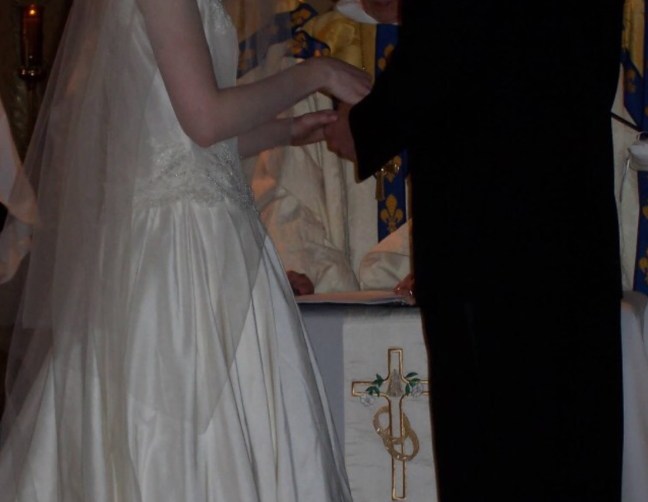
God’s mercy is poured out on idiots, too, of course; I made a lot of good decisions in spite of myself. I had a clear sense, dating my future husband, that God was offering me the choice – did I want to spend the rest of my life with this man? We were married after my second year of law school. My story should end here, of course: I had gained the laurel I had longed for at 21. I knew my state in life. What more was there to do?
I think my marriage illustrates how God thoughtfully tailors graces for particular people. My husband and I had not remotely addressed all the wounds we both carried from our lives up to that point; indeed, we were probably oblivious to many of them. And we were utterly naive about how difficult it could be to love someone broken when you are broken yourself. The sacrament offers an opportunity to find healing together, but also, of course, the potential for collateral damage.
None of this distracted me from my view of how marriage was supposed to work. We started trying to have kids immediately, even though we weren’t entirely certain how we would support them. God provides, we knew. What God did not provide, in our case, was children. After a seven-year battle with fertility treatment, we had no babies, and my faith was in tatters. I never doubted the truth of the faith. But my sense of God’s love and goodness, always rather fragile, was shattered. I had been willing – frantic, even – to give up my precious career for a quiet life as a wife and mother. I was willing to sacrifice everything I had, and God wouldn’t even TAKE it. I knew I did not deserve the gifts I sought, but His rejection seemed malicious. By then, I had a full-time job with interesting work, good pay, and decent hours, living in a community surrounded by good friends. God could not have called me to all the things I was supposed to give up. Where had I gone wrong?
My early answers to the questions of faith and discernment weren’t holding up. Happily, life’s pitfalls offer opportunities to reevaluate. I realized that while I worried about choosing the wrong vocation, I had been getting wrong who God was – and had been building on that fractured foundation ever since. I’ve never been patient, and the idea that I couldn’t get all this right in the first place is maddening. But perhaps God has allowed me to see the need for healing at the earliest time it could have done me any good. My project, then, is to learn to trust Him truly; and thereby, I hope, to see His plan to make my life fruitful from the place He has put me.
I remember my time in college very fondly, but I was obviously deaf to all good sense. With the hope that you now starting on this journey are wiser, I will merely plagiarize St. Therese: we must be littler, and let Him do all. You already have all of His love – now, today. It is not something you’re working toward, and certainly not something you’re earning. Accept His love, ask Him to bring you closer to Him, and He will show you His plan for your life – always different, more difficult, and more beautiful than your plan for yourself.
AMD ’03
 Quo Vadimus?