Gazing,
pondering your intentions
make and unmake
the mess,
my expectations
Slimmed down
self
shame less, ready
to receive my due –
drops to fill
overflowing spill of You.
As a wife of 10 years and stay-at-home mother to three young children, only now can I begin to appreciate why my parents’ wedding song (married 46 years now) is “My Cup Runneth Over.” The vocation of marriage and children brings such abundant, overflowing infusions of God’s love on a daily basis. If only I can see through the overwhelming parts – a mix of manual labor and hostage negotiation, emotions sometimes running wild on all sides. God loves each of us generously. “This is my body given up for you.” And so it is when two become one, when you labor to carry and bring children into the world, when every day you are stretched body and soul to love them as Christ loves you, yourself a beloved Child of God. Our families and the world at large need our faith: “Receive me with maternal love.”
My education in the life of the Soul took root at Williams and I am forever grateful. It was a fruitful time of questioning and choosing Love over other gods and conditional substitutes. “Yes, there are two paths you can go by/ But in the long run/ There’s still time to change the road you’re on. And it makes me wonder…” (Led Zeppelin). May your heart, mind, soul, everything within you be reawakened to the reality of God’s merciful love for you at Williams. May it overflow into your vocation, beyond.
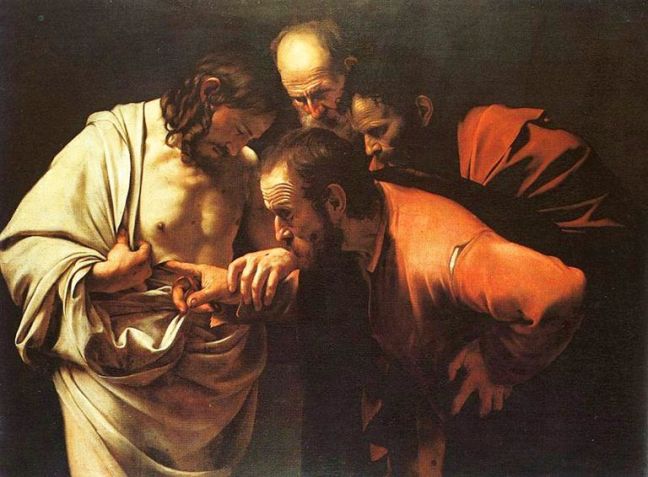
The 3rd of July is the Feast of Saint Thomas the Apostle. “Doubting Thomas,” as he is commonly known, gets his moniker from his refusal to believe that Jesus has risen from the dead. “Unless I see the marks of the nails in his hands and put my finger into the nail marks and put my hand into his side, I will not believe.” (John 20:25)
I always thought that Thomas gets an undeservedly bad rap. When someone is labeled a “Doubting Thomas,” it is usually not a term of endearment for their healthy skepticism or their careful mind, but instead a mocking nickname for their stubborn refusal to acknowledge an apparent truth, or their tendency to produce objection after objection in an effort to dispel what is obvious to everyone else. One can almost see Thomas with his arms folded, impassively shaking his head (and perhaps even stamping his feet) as he rejects the testimony of his fellow disciples. And one can perhaps imagine the disciples chuckling to themselves when Jesus appears and tells Thomas, “Put your finger here and see my hands, and bring your hand and put it in my side, and do not be unbelieving, but believe.” Thomas, chastened, responds, “My Lord and my God!” Jesus then seems to chide Thomas: “Have you come to believe because you have seen me? Blessed are those who have not seen and have believed.” (John 20:27-29) Silly Thomas! How little faith he has! This was the image I had in my mind as a child when I first heard this story, and though it was certainly a caricature, it stuck.
But, if we stop and think for a moment, this caricature makes little sense. Thomas is unlikely to have stubbornly folded his arms like a spoiled child. He had just lost one of his closest friends to a grisly death barely a week before. John’s Gospel relates how Thomas urged the disciples to return with Jesus to Judea upon the news of Lazarus’s death, knowing full well the risk to Jesus’s life and their own lives at the hands of the Pharisees (“Let us also go to die with him.” John 11:16). How did Thomas feel knowing that he himself lived even though his Lord and friend had suffered and died? He was certainly in the throes of deep mourning and wracked with guilt, perhaps haunted by the bravado he had shown earlier when he had declared his willingness to die for Jesus. Like the other disciples, I imagine that Thomas had high hopes that Jesus would usher in the Messianic Age in his own lifetime, leading an army to drive out the Romans and restore Israel’s sovereignty. The death of Jesus—and a deeply shameful death at that—seemed also to mean the death of Thomas’s own dreams. Thomas was a man who had put all his eggs into one basket, and it now seemed as if the world had seized that basket and unceremoniously hurled its contents off a cliff.
So, when the disciples tell a grieving Thomas the incredible news that Jesus has risen, I can imagine that he is not yet ready to accept it. His own wounds are too fresh. He cannot bear to stir the embers of his fading hope only for them to be extinguished altogether. For Jesus’s resurrection to be anything other than his friend and Lord truly come back to life would be too much—a twist of the knife, a macabre teasing of the bereaved. Imagine burying a loved one and hearing a friend tell you that that person has come back to life. How could it be anything other than a cruel joke?
Critically, though, there is a part of Thomas that wants to believe that Jesus has risen. He does not say, “It is impossible! Don’t speak such nonsense! The Lord has not risen!” After all, he witnessed first-hand Jesus raising Lazarus from the dead. There is reason to hope, even if hope is a hostage to fear. Though Thomas fears having his heart crushed by disappointment again, he is willing to open it a crack. Hence, he admits that he would be convinced if only he could see Jesus alive with the marks of his crucifixion. That’s all Jesus needs. Just as He entered the locked Upper Room to comfort the frightened disciples, so too did He enter Thomas’s wounded heart to reassure him. Jesus knew Thomas’s heart; Thomas was not trying to test God. He wanted the resurrection to be true, but like an injured child who craved the reassurance of his mother, he needed God’s reassurance. Thomas sought the faith that would allow him to believe in the risen Lord, and as Jesus promised in Matthew 7:7-8, he found what he sought. Tradition holds that “Doubting Thomas” became one of the most peripatetic of the Apostles, bringing the Good News of Christ as far as India, of which he is now patron saint. Clearly, whatever pain or doubt Thomas harbored before he met the risen Christ was replaced by a great inner peace and fearlessness.
What Thomas can teach us, I think, is that our faith need not be perfect. The desire to believe in Jesus is enough for the Holy Spirit to plant the mustard seeds of faith within us. This is the key difference between Thomas and someone whose skepticism is aimed at dispelling religious belief. The former seeks in order to find; the latter is only interested in finding evidence that the whole search is futile. All of us struggle at times with the belief that God is indeed always with us and that He indeed loves us. Suppose that we could be convinced of that, not just intellectually but deep within ourselves. How would our lives be different if we were freed from all fear? What marvelous things would we dare to do? If we can imagine and earnestly desire that faith, freedom and inner peace, then I believe God will grant it to us, just as he did to Thomas. Would that our doubting be like Thomas’s!
I’ve become kind of a shameless groupie of Fr. Jacques Philippe. It snuck up on me. But at some point, I realized I’d read three of his books, had every intention of getting more, and was really looking forward to seeing him in person when he gave an evening of recollection in my city – and getting a bunch of friends to come with me. It’s only going to get worse from here.
I suppose what particularly attracts me is the feeling that his ideas and guidance are offered to me specifically. Prayer and discernment can be lonely; it’s easy to feel that no one is listening – and perhaps never will.
Since the defining feature of my life (more even than my groupie status) apparently is smartphone dependence, I always seem to have something playing on YouTube, especially during my mind-numbing commute. I have a little bet with myself over whether I’ll be more disappointed if I don’t get to hear the end of an hour-long talk, or if the drive actually takes that long. And so it was that I recently found myself propping my phone up on the kitchen counter (gotta make the most of that natural amplifier) so I could hear the rest of this reflection while I settled in for a productive evening of baking:
Somehow, the pacing – a moment to hear a phrase translated into English, and another to digest it while he delivers the next in French – was perfect for my addled brain to absorb while I fussed about with my recipe. I always want to be peacefully resting in a moment when I am doing exactly the right thing – in this case, stealing the little spare time in a busy week to make a quiche for a colleague’s farewell like I said I would – but I am confronted with the fact that I never seem to find myself stealing a spare 90 minutes for prayer. A talk may be edifying, but is it the spiritual life, really? Because that’s what I’m pretty sure needs the most attention in my life right now. (And, let’s be honest, always. Martha, I think I understand. But Mary…)
Funny thing – sometimes YouTube is a perfect instrument of grace. As I listened, I felt a ray of unfamiliar light breaking in on my life. Among many other thoughtful things, Fr. Philippe offers an insight I had never heard. He suggests that we view discernment of the will of God in our lives in three parts. One he identifies with the Son: obedience to the moral law offered by Christ and His Church. Another, with the Holy Spirit: receptivity to the stirrings of the Spirit in our hearts. And the third, with the Father: God’s path, specially tailored for us through His providential love, shown through the events that befall us – even, and perhaps especially, the setbacks and sufferings.
I know God has a great potential in mind for each of us – a heroic purity of love, and large and small things done with great enough love to change the world. Personally, I want to achieve that full potential in a bolt of lightning (but maybe without falling off a horse or being blind for a week. Or imprisoned. Or beheaded). But, however reluctantly, I can appreciate that that’s not how it’s going to work; it will be a long process, and, like any process of refinement, one with plenty of friction. The greatest sadnesses in my life are not, perhaps, evidence that God does not care enough to bother, that I have too little to offer to receive some of the blessings that others do. Perhaps – painful as some of these crosses are – they were chosen with great foresight, with great love, because only with them could I arrive at some still-greater thing, as yet unseen, that He has meticulously planned for me. I’m not ready to say, with St. Therese, that I choose every privation my life could contain. I need to grow in trust a lot more before I’m unafraid to hand over a blank check like that. But I may be ready to turn and face some of the crosses I have stumbled under, and to tell God in all sincerity that I choose them, that I am ready and willing to keep them – not with bitterness or fatalism, and not with the veiled hope of a plot twist that will suddenly remove them, but in a genuine faith that they will make me something better than I am. A tiny gift, but for me, precious indeed.
It’s a long video, and, of course, what each of us needs to hear – even what one needs on any given day – will vary widely. But if you have a soul-crushing commute of your own, or a bit of quiet housekeeping to do, check out the talk. I hope you find a treasure of your own (and would love to hear about it if you do).
One warm summer evening, I found myself sitting alone in my room in Perry House and asking myself this very question: “What will I find here?” It was the summer before my Freshmen year at Williams, and, already, I was overwhelmed by the natural beauty of the campus, the academic rigor of the institution, and the intense and passionate nature of its people. Indeed, I would spend my next four years at Williams both battling to discover my place in this community and truly embracing it as my home, and now, on the eve of my graduation, I’m finding myself asking the question “What did I find here?” Certainly, I have found the academic passions, lifelong friends, and appreciation for community that were advertised in the brochures. However, what the brochures did not advertise and that which I did not expect to find (and for which I am so grateful to have found) was faith.
Coming into Williams, religion (and the practice of it, for that matter) was far-removed from my mind. While I was baptized in the Church, received First Communion, and was confirmed, my family usually only attended Mass on Christmas and Easter. It was only at Williams (at the behest of another student that I attend Mass with him one sunny Sunday morning) that I began attending Mass regularly and taking my faith more seriously. I am constantly in awe of the fact that, at Williams, I found a place not only to develop my intellect, but also to nourish my soul and to more fully develop my Catholic faith. Indeed, as a young woman who began the process of discerning her vocation here at Williams (and who will continue to do so after graduation), I have found the stories by these alumni, whether by priest or nun, religious or lay, or married man or woman, particularly inspiring and comforting on my own journey of growth and discovery.
Whether you are thinking about or still discerning your vocation or have already found your calling, I hope that you find these stories as fruitful and heartening as I have. As you begin your journey on this website, reading about the different paths that alumni have been called to take, don’t be afraid to ask yourself the question: “What will I find here?” Indeed, it could be something great.
I was hoping I might run into you here eventually.
If, like me, you graduated from Williams many moons ago, then you’ll nod in familiarity when I say that I little guessed, on my bittersweet graduation day, how keenly I would yearn for the days when dear friends were always just a five minute walk away for a shared meal, a helpful review of a tricky essay, or a much-needed coffee break. I would have been bewildered – and distressed – by the idea that a seemingly unbroken conversation forged of chance encounters on a sidewalk, electronic messages of all kinds, synchronized snack bar runs, and even the occasional old-fashioned phone call would devolve, out in the “real” world, into scheduled catch-up phone calls; then periodic emails; then sporadic ones. Whole years, passing by unbidden.
And so I was particularly charmed, one day two years ago, to hear from a classmate who had entered the religious life. (No sporadic catch-up emails here – only letters!) He explained that he had a new project in mind – and that he was volunteering me to help. Some things really don’t change that much, after all. He had had the extraordinary blessing of being able to teach a Winter Study class, and meet some of the current crop of Catholic Ephs; and he thought that the soon-to-graduate might benefit from hearing from Catholic alumni about their paths (so far!) to discerning where God is calling them. He had even found a volunteer among the Winter Study crop, who could help us offer something relevant to what current students might be looking for.
I was skeptical, of course (I haven’t changed that much myself). Why would the undergraduates want to hear from us? But the suggestion gave me a very welcome excuse to reach out to some fellow alumni (who actually use email), and they thought the idea had potential. I assumed by this they meant to volunteer to contribute essays, so we were off to a roaring start.
Of course, our efficiency is never what we imagine it will be; slowly but surely, however, we’ve made our way here. We won’t know this side of heaven what fruit this (or any) of our efforts will bear. Already, however, I’ve had the privilege of learning more about the beautiful stories unfolding in the lives of people I’ve dearly missed – and in the lives of some I’m only now, through this effort, getting to know, including one particularly delightful member of the class of ’17.
I hope that this will be only the beginning of many years of conversation about where our lives will lead, and be led; and I hope that this tiny corner of the internet will provide us an opportunity to discuss our adventures in discernment with current students, and the ever-growing crop of new alumni.
 Quo Vadimus?